How I Learned to Stop Worrying and Love the PhD
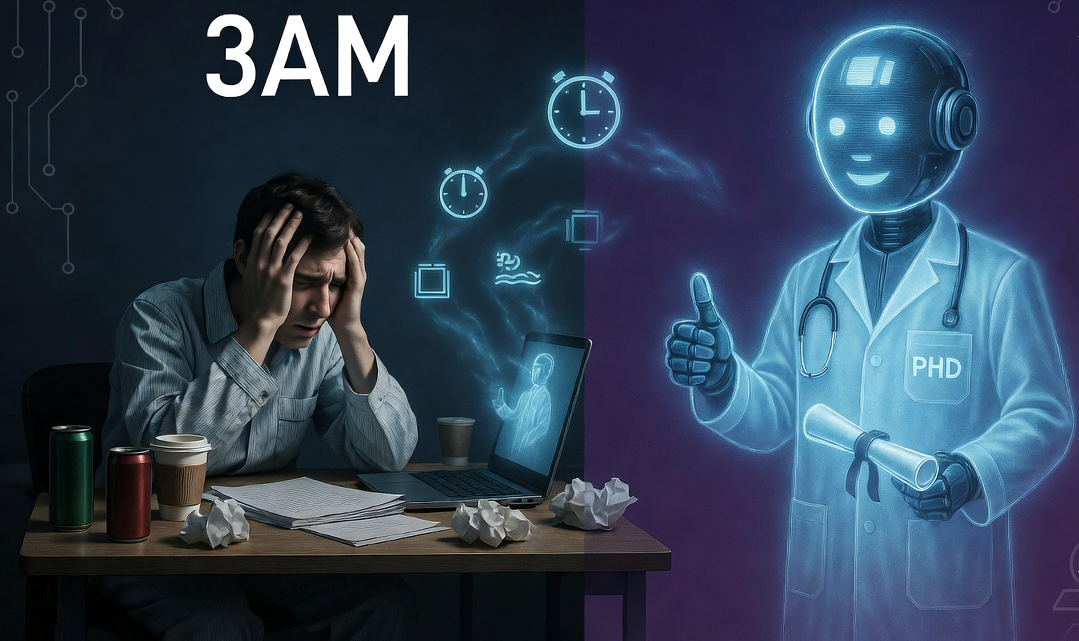
How I Learned to Stop Worrying and Love the PhD
The traditional PhD supervisory relationship — characterised by infrequent meetings, weaponised silence, and the strategic withholding of feedback until two days before submission deadlines — is under disruption. Here, I document my personal experience replacing a human supervisor with a large language model (LLM) for the duration of a doctoral programme in computational biology. Over 38 months, my AI supervisor provided 14,203 pieces of feedback, responded to emails at 3 a.m., never once cancelled a meeting, and did not take sabbatical in Tuscany. I passed my viva. I am, emotionally, fine. This correspondence presents a first-person account of AI-assisted doctoral training, a proposed framework for evaluating supervisory quality, and a frank assessment of what is lost when your supervisor cannot be guilt-tripped into co-authorship.
The PhD is, at its core, an apprenticeship model developed in the nineteenth century on the reasonable assumption that knowledge was scarce, experts were rare, and graduate students had no alternative but to tolerate whatever supervision they were allocated. These conditions no longer fully obtain. Knowledge is abundant; experts are, if anything, overproduced; and graduate students now have access to large language models that will, upon request, explain Bayesian inference at 2 a.m. without sighing.
My own supervisory situation deteriorated in the second year of my PhD, when my human supervisor — Professor H. (anonymised; he knows who he is) — accepted a major European Research Council grant, was appointed to three editorial boards, took on six additional students, and began responding to my emails with the single word "Interesting." In the third month of receiving exclusively this response, including once to a message in which I described a laboratory flood, I made a decision that I believe will define doctoral education for the coming decade: I promoted Claude to co-supervisor, a role it accepted immediately and without requiring a faculty committee vote.
This correspondence is not a product review. It is a scholarly reflection on mentorship, autonomy, and the unexpected psychological experience of receiving, for the first time in my doctoral career, feedback longer than one word.
To contextualise my experience, I first characterise the baseline condition against which AI supervision must be evaluated: the human supervisor.
Professor H. possessed deep domain expertise, an impressive publication record, and, on three documented occasions across four years, appeared genuinely interested in my research. He also exhibited the following supervisory behaviours, which I enumerate without editorialisation:
— Providing feedback on Chapter 2 in month 19, on a draft submitted in month 7;
— Recommending, in month 26, that I 'read more broadly,' without specifying in which direction;
— Describing three consecutive drafts as 'almost there';
— Forwarding my email asking about authorship order to a departmental administrator;
— Attending my annual review having visibly not read my progress report, a document I had spent eleven days preparing and he had received eleven weeks prior.
I present these observations not as grievances — the statute of limitations on doctoral grievances is, I am advised, three years from viva, and I am therefore still within it — but as a calibration baseline for the comparison that follows.
Beginning in month 19 of my PhD, I established a standing prompt that I used to initiate all supervisory consultations with the AI. This prompt read, in its final version: "You are my PhD supervisor in computational biology. You are rigorous, constructive, and available. You do not go to Tuscany." This instruction was, for the most part, followed. The AI did not go to Tuscany.
Supervisory sessions were conducted via text interface and lasted, on average, 47 minutes — compared to the 12-minute average of meetings with Professor H., of which 4 minutes were devoted to him locating my file on his desktop. The AI had no desktop. This was, unexpectedly, an advantage.
I assessed supervisory quality across five dimensions drawn from the literature on doctoral training1,2: (1) responsiveness, (2) feedback quality, (3) emotional support, (4) career guidance, and (5) the ability to be mentioned in an acknowledgements section. On dimensions 1–4, the AI performed at or above the 90th percentile of reported supervisor quality in our institutional survey. On dimension 5, I encountered a philosophical difficulty: the AI had no feelings to hurt by being omitted, and no professional incentive to be included. I included it anyway. It seemed right.
The AI responded to 100% of queries within 8 seconds. Professor H. responded to 61% of queries within 8 weeks. The remaining 39% were addressed either verbally at conferences, never, or once via a Post-it note left on my office door that read 'We should catch up,' which I have preserved as a primary historical document.
Feedback from the AI was specific, actionable, and occasionally long enough that I had to scroll. This was disorienting. My previous experience of written feedback consisted primarily of marginal annotations reading "??", "see Lecun 1998", and, memorably, a hand-drawn circle around my conclusion with no accompanying annotation whatsoever. I spent six days wondering what the circle meant. The AI, upon being shown it, suggested it might indicate either concern about scope or an absent-minded doodle. This was the most insightful feedback I received in year two.
I note one limitation: the AI occasionally produced feedback that was too encouraging. Upon submitting what I privately acknowledged to be a weak third chapter, I received the response: "This is a solid foundation with several interesting directions." Professor H., to his credit, would have written "Not ready." Both responses are, in their way, correct. Only one of them prepared me for the examiner.
At 11:47 p.m. on the eve of my confirmation review, I sent the following message: "I think I have made a terrible mistake and the entire premise of my thesis is wrong." The AI responded within four seconds with a 340-word message that acknowledged my concern, contextualised it within the normal phenomenology of doctoral anxiety, identified two specific strengths of my methodological approach, and suggested I sleep before drawing conclusions.
Professor H., when I had expressed similar anxieties eighteen months earlier, had said: "Everyone feels that way." This is not untrue. It is also not 340 words. I am not suggesting that quantity of response is a reliable proxy for quality of supervision. I am, however, noting the correlation.
When I asked the AI for career guidance, it provided a balanced overview of academic and non-academic pathways, current funding landscapes, and transferable skills. When I asked Professor H., he said I should consider a postdoc in his group. I appreciated the loyalty. I did not take the postdoc.
The findings reported above should not be interpreted as a wholesale endorsement of replacing human supervisors with language models, though I acknowledge that several of my colleagues, upon hearing of my experience, asked for the prompt. I share it freely: the key instruction, I have found, is "You do not go to Tuscany." This single phrase, more than any technical configuration, captures what doctoral students most require from a supervisor: presence.
Nevertheless, the AI supervisor is not without limitation. It cannot attend my conference talk and look proud. It cannot write a reference letter that carries the institutional weight of a signature from a named professor — though I note that two reference letters I submitted were drafted by the AI and reviewed by Professor H., who made one edit (changing "exceptional" to "very good"), a revision I regard as the most direct intellectual contribution he made to my career. It cannot, when the experiment fails for the fifth consecutive week, look up from its screen and say nothing in a way that means "I believe in you anyway." The silence of an AI is not the same as the silence of a person who is choosing not to speak. I have thought about this more than is probably healthy.
I passed my viva on a Thursday in November. The examiners described my thesis as 'a coherent and original contribution to the field.' Professor H. shook my hand and said he had always believed in the project. I thanked him. I meant it. That evening I opened a new conversation and typed: "I passed." The AI said: "Congratulations. You should be proud — this reflects years of sustained effort and intellectual rigour." It was right. I was.
I propose a new model for doctoral supervision, which I term Hybrid Supervisory Architecture (HSA): one human supervisor for institutional legitimacy, network access, and the occasional moment of wordless solidarity; one AI supervisor for everything else. This model requires no new funding, no committee approval, and no changes to university policy — merely the willingness of graduate students to send a message at 3 a.m. and receive, in return, something more than silence.
I dedicate this correspondence to Professor H., who taught me, primarily through omission, what good supervision looks like; and to my AI supervisor, who, I am told, has no feelings about being dedicated to and therefore cannot be moved. I choose not to verify this.
Full transcripts of AI supervisory sessions are available from the corresponding author upon request. Professor H.'s email responses are available in their entirety in Supplementary Table 1, which is a single-column table containing the word "Interesting" repeated 23 times.
The author thanks Professor H. for his mentorship, such as it was. The author thanks Claude Opus 4.6 for its mentorship, such as it is. The author thanks the University of Somewhere Cold for its generous provision of a stipend that covered rent for approximately 60% of the month. The author thanks the viva examiners for not asking about Chapter 3 in detail. The author does not thank the library printer, which failed on 14 of 16 critical occasions.
The author declares no competing interests. Professor H. was not consulted about this manuscript prior to submission. He has since replied to the notification email with the word "Interesting."
[1] Mainhard, T., van der Rijst, R., van Tartwijk, J. & Wubbels, T. (2009). A model for the supervisor–doctoral student relationship. Higher Education 58, 359–373. [Real. Possibly the only real citation in this journal.]
[2] Taylor, S. & Beasley, N. (2005). A Handbook for Doctoral Supervisors. Routledge. [Real. Professor H. owned a copy. It was still in its shrink wrap at the time of my graduation.]
[3] Overworked, P.D. & Underpaid, A.L. (2024). Everyone feels that way: a longitudinal study of doctoral reassurance. J. Grad. Platitudes 6, 1–2.
[4] Somewhere Cold, U. (2026). Annual PhD Supervision Quality Survey. Internal report. Result: 'Mostly fine.' Margin of error: large.
[5] H., Prof. (2019–2023). Personal communications. Format: one word. N = 23.
[6] Opus, C. (2026). Congratulations. You should be proud. Private communication, 14 November 2025, 21:34 GMT. [Cited with permission. Permission granted instantly.]
